How to reduce late delivery?
One person was routing every order, every customer question, every logistics release. Manually. Through email. We didn't touch the underlying setup. We built an autonomous layer on top of it.
CEO time recovered every month

Fresh produce, autonomous flow.
Sanco is a Swiss fresh-produce exporter (essences, juices, purees). The four autonomous systems sit above the tools the team already uses, so every order and every question moves through without a person minding the inbox.
Two surfaces. One for the operator, one for the engine.
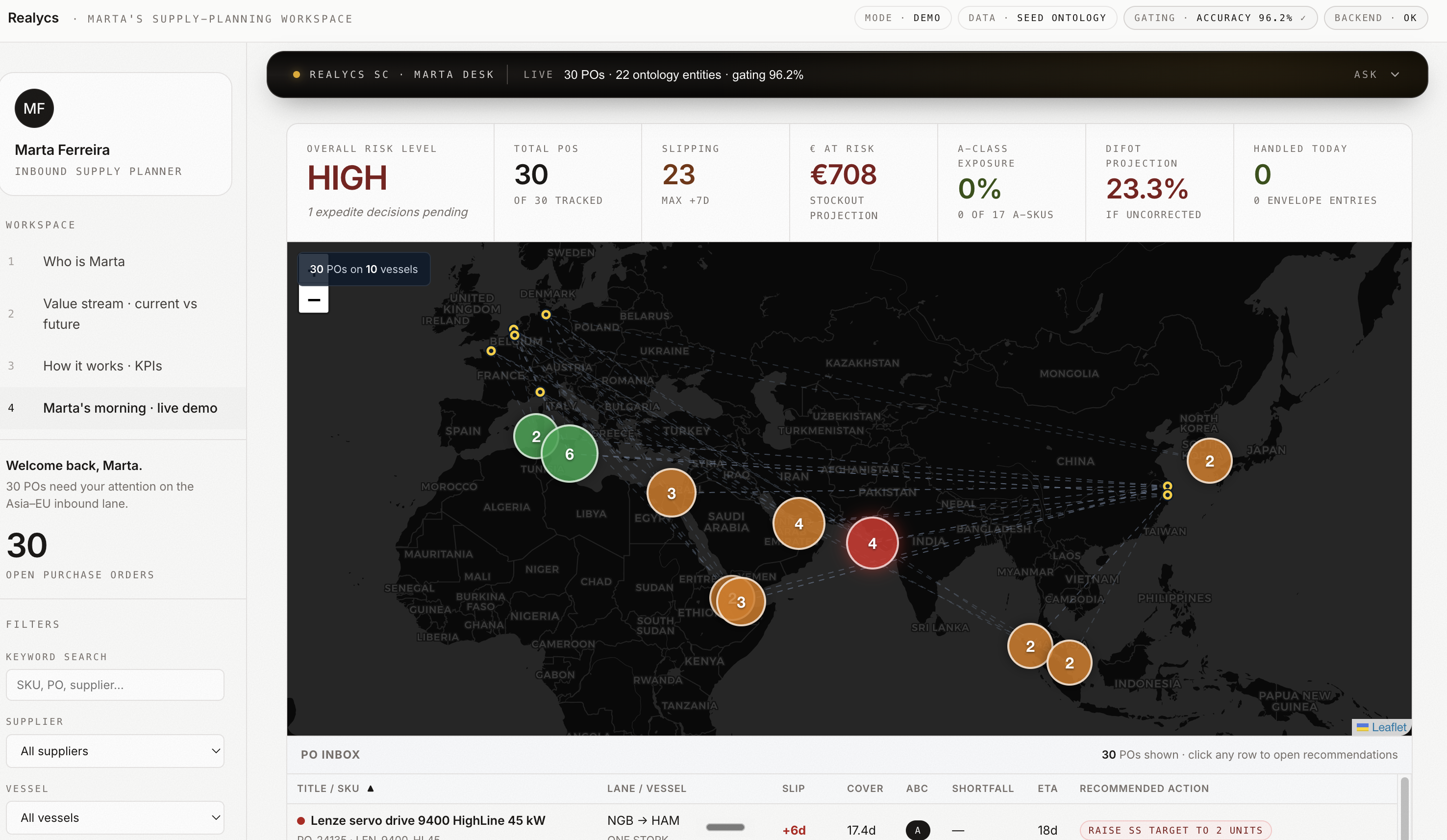
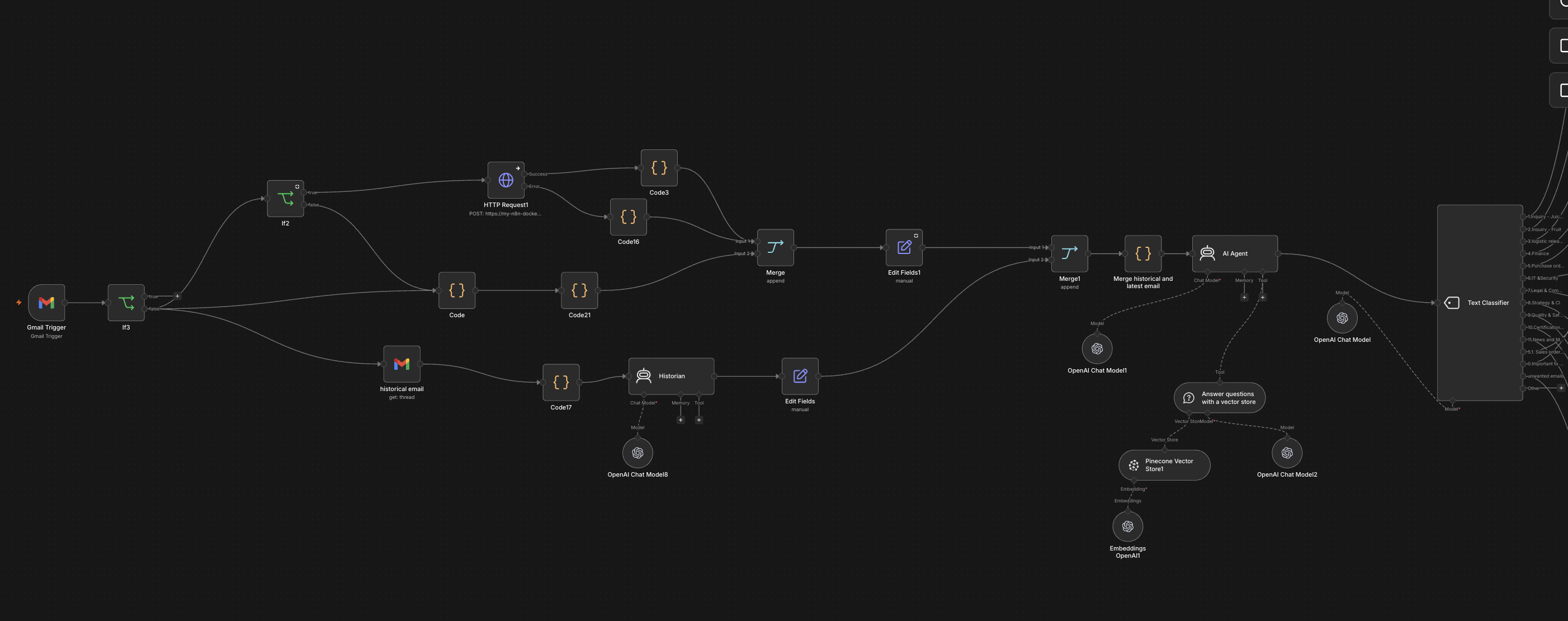
The operator gets a single console that supervises every flow. The engine runs on the side, invisible to the desk, orchestrated as a versioned workflow.
One inbox, one person, every process.
Sanco is a small, fast-moving fresh-produce exporter. Every commercial signal came in as an email: a customer placing an order, a supplier confirming a shipment, a customs question, a logistics release. All of them landed in the same inbox.
One person was the fallback for all of it. Reading. Classifying. Routing. Replying. Chasing. Filing. When they were unavailable, work waited. When volume spiked, judgement calls were made under pressure and things fell through.
The company needed the mechanical steps between systems to stop consuming human attention. A three-year SAP transformation was the wrong shape. A thin autonomous layer on top of the existing setup was the right one.
Four autonomous systems, and one control layer that supervises them all.
Four independent systems, each with a single job, each independently observable and pauseable. A control layer sits on top so the owner sees the state of every flow in one place.
Email intelligence
Every incoming email is read, categorised (customer order, product question, supplier update, logistics event), and routed to the workflow that owns it. No one touches the inbox to make this happen.
Customer replies
Product questions get an accurate, grounded reply drawn from the product database. Escalates to the team only when human judgement is actually needed.
Order to five-output chain
One confirmed order triggers, in parallel: the truck driver briefing, the certificate of conformity to the customer, the customs notification, the release-calendar block, the compliance check. Zero manual steps.
Control tower
A custom web interface. The owner sees every active flow, can inspect any execution, pause or re-run any system, forward or override any message. Without opening a single automation tool.
The four systems, one control layer.
Judgement stayed with the team. The machine handles the handoffs.
Before, per customer order
- Read the email, classify it.
- Brief the truck driver manually.
- Draft and send the certificate of conformity.
- Notify customs by hand.
- Block the release calendar.
- Run and file the compliance check.
After, per customer order
- The order email arrives.
- Five outputs fire in parallel.
- The owner watches the control tower.
Composable workflows, one owner-facing surface.
The four systems sit on n8n. Each workflow is transparent, versionable, and repairable independently. The control tower is a lightweight web app that consumes the workflows through their APIs and exposes them behind a single owner-facing UI. Nothing in the day-to-day operation requires opening an automation tool.

Every one of the four systems runs as an independent, versionable, repairable n8n workflow. Transparent enough for the owner to inspect, robust enough to run overnight.

Reads the shared inbox, categorises every message (order, product question, supplier update, logistics event), routes to the workflow that owns it.
Grounds every customer reply in Sanco's own product database. Escalates to a human only when the retrieval confidence drops below threshold.

One owner-facing screen shows every active flow and every recent execution. Supabase holds the state (executions, routings, interventions) with row-level security.

Every certificate, every quality doc, every logistics artefact lands in Sanco's SharePoint. Nothing gets duplicated into a new file store.
Any workflow can be swapped, paused, or rewritten without touching the others. The supervising UI is the single owner-facing surface.
If one inbox is holding your business together, there's a lighter way to run it.
Apply for a Free Build